
There's
much more to Fiji than the famous Great White Wall and Beqa Lagoon. Diving
historic Bligh Waters from a liveaboard is a great way to experience the
best Fiji has to offer; everything from pipefish and blue ribbon eels to
mantas and hammerheads. And almost everywhere you look you will find some
of the most impressive soft coral formations in the world.
Each dive offers something unique. After
embarking in Lautoka the NAI'A visits either Sunset Ridge or Nukurauvulu
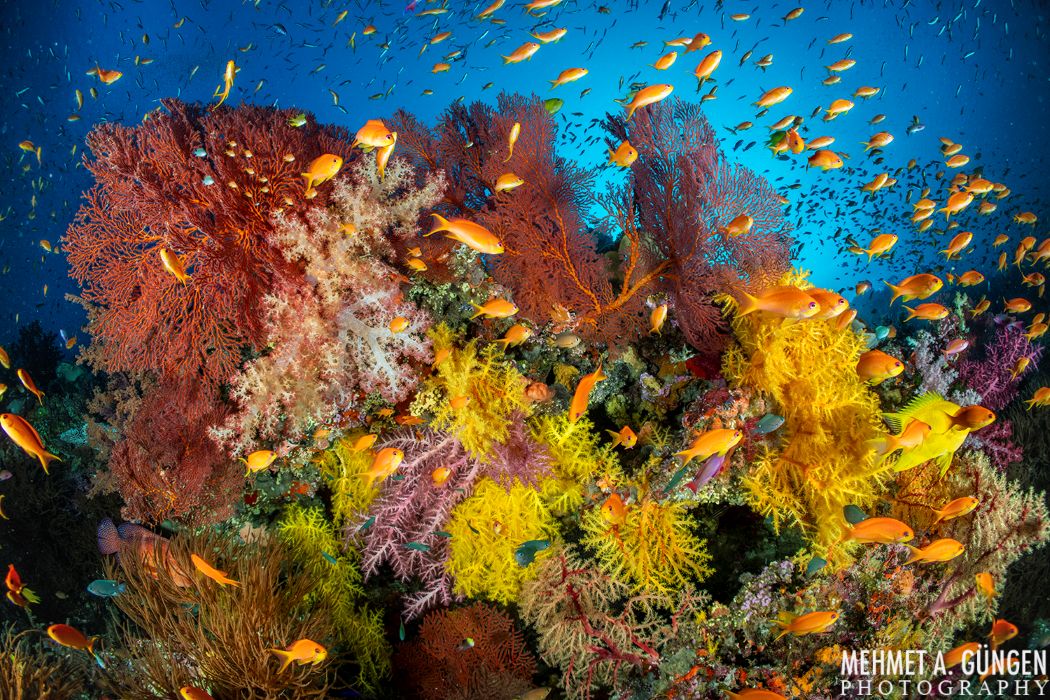
Reef. Although yellow corals are found throughout Fiji, they are perhaps
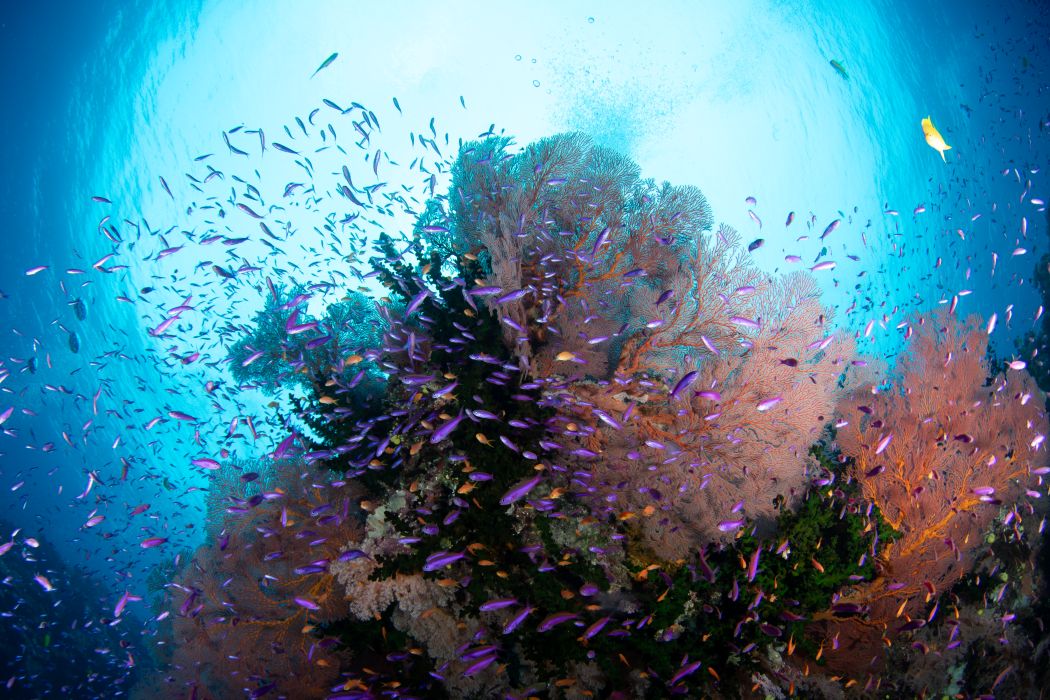
less common than the redder soft corals. At Sunset Ridge there is an entire
wall of these yellow beauties between six and thirty metres. Multitudes
of pink/purplish anthias cavort above the coral in brilliant contrast.
Lionfish and flower cod can be found hiding in the crevices; the area is
dotted with anemones as well. A night dive at Nukurauvulu revealed a type
of ornate pipefish which we weren't able to classify and a prehistoric-looking
shovel nose lobster.
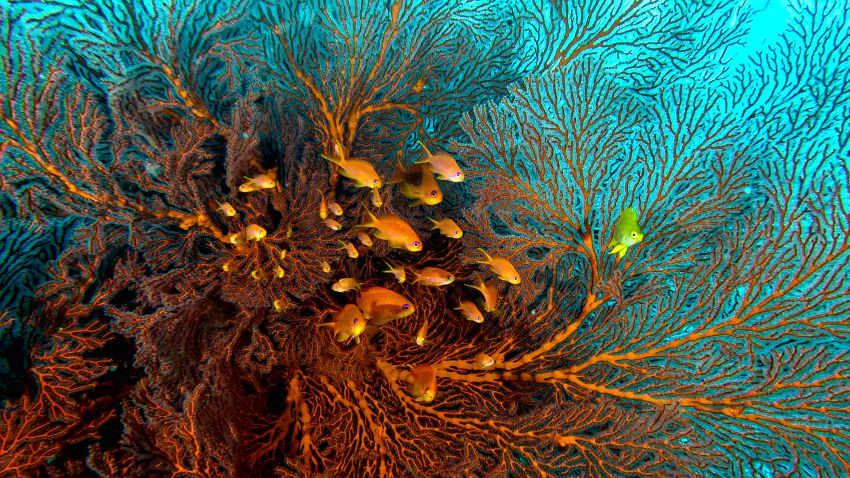
Owner/skipper Rob Barrel discovered E-6 Seamount after studying oceanographic charts and aerial reconnaissance of the area. The area is so named because it is truly a photographer's dream. The mount rises from 914 metres and at low tide the tip of it can be seen grazing the surface. The perimeter is a site to watch for hammerheads, tuna and other pelagics. The surrounding wall features lionfish, saddlebacks, and puffers. Perhaps the most beautiful spot, the Cathedral, or the Sistine Chapel, is reached by a swimthrough. The crescent shaped passage featured huge gorgonians and a variety of soft corals. Depending on the time of day, shafts of light filtering through holes in the coral formations overhead bathe the passage in a otherworldly glow. For those not inclined to shoot wide angle, nudibranchs, lobster, and crabs are plentiful in the coral and crevices. Flashlight fish and cuttlefish can also be seen, but are less common.
Rob
occasionally dos an exploratory dive like the one we did at Mystery Pass.
We found a variety of nudibranchs, pyramid butterfly fish and a patch of
garden ells. During a night dive at Namena's South Save-a-Tack we found
a pair of leaf scorpionfish. The following morning on Namena North Save-a-Tack
there were great bommies brimming with a variety of butterflyfish, emperor
angelfish, puffers, an occasional whitetip shark and a small school of
barracuda. For those looking for macro critters there was even a pair of
porcelain shrimp. Nearby is an arch where there was a paid of clown triggerfish
and a titan triggerfish busily biting chunks of coral.
If you're looking to cover a lot of territory on a single dive, start out at Grand Central Station where there's a massive school of barrracuda, grey reef sharks and titan triggers. Then float away to Kansas. Known in the US for its golden wheat fields, this bommie is covered with sinularia, a type of coral which give the appearance of wheat shimmering in the sun. There is a spectacular profusion of soft corals on the back side of Kansas - yet another treat for wide angle photographers. And if the current picks up, you might get blown over to Oz, a nearby bommie that is completely different but every bit as interesting.
A
trip to Wakaya means blue ribbon eels. These fascinating creatures live
in crevices, often surrounded by small sandy areas. Their cobalt blue colour
makes them one of the most colourful and most easily identifiable of all
eels. There are also pipefish and nudibranchs here. But as with much of
Fiji, Wakaya is another photographer's dilemma - not only are there small
animals, but mantas, schools of barracuda hammerheads and other sharks
frequently cruise the area. Look for Stubby, a reef shark with part of
his pectoral fin missing.
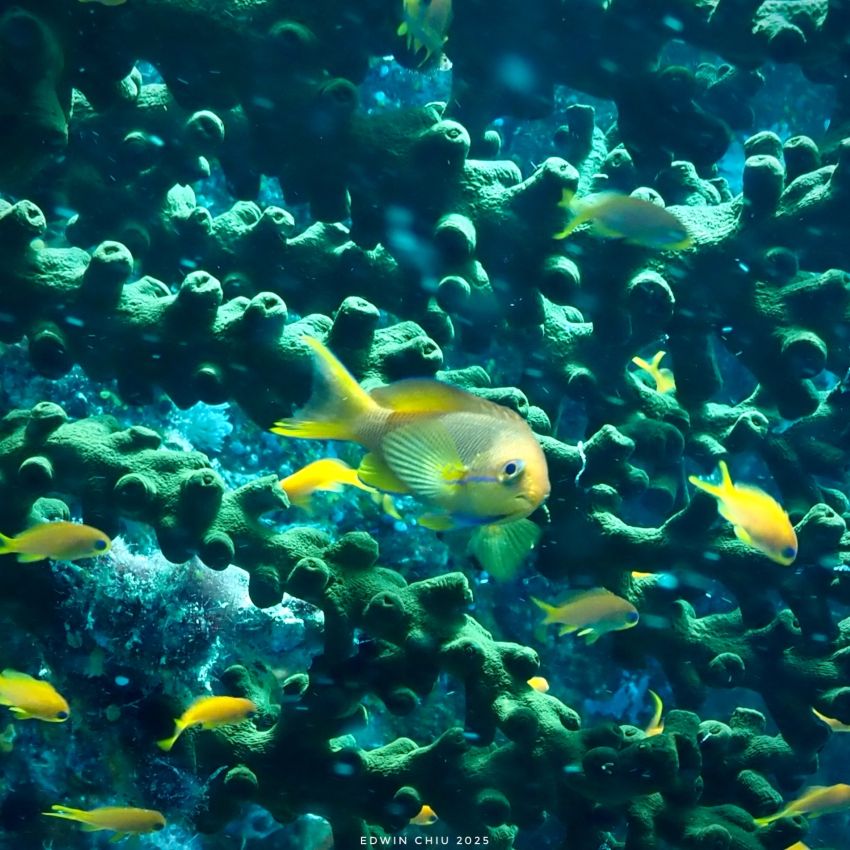
There are at least three excellent dive spots located near the island of Gau. During a dive on Anthias Avenue, we found plenty of the titled fish but also a pair of mating nudibranchs, a juvenile clown triggerfish, a multitude of lionfish and several colourful tridacna clams. Jim Church did an exploratory dive at a spot that became known as Jim's Alley. The site has several bommies loaded with soft coral. We also found a curious black goby, a number of blue dash butterfly fish and a pair of long- nosed hawkfish nestled in finger coral.
The
most exciting dive around Gau has to be Nigali Passage. The pass itself
carries water from the deep ocean into a more shallow lagoon. The area
always attracts a variety of sharks. The dive starts calmly enough at about
24 metres on a coral- strewn sandy plain, usually with a little bit of
current. The further into the pass you go the more interesting the fish
become. First to appear are the snappers followed by the occasional flower
cod. As the current begins to increase, a school of barracuda appears.
At about the same time grey reef sharks whitetip and blacktip sharks also
enter. The NAI'A does several dives at Nigali Passage so that divers can
get used to the orderly nature of events. Following a thorough dive briefing,
the last dive there is a shark feed. To exit Nigali Passage you just let
the current take you through one of two openings into deeper and calmer
waters. One of the exit sites is known as the Cabbage Patch because of
the leafy appearance of the coral.
One highlight of a trip aboard the NAI'A has nothing to do with diving. Arrangements have been made with a village on Gau for passengers to visit. The friendliness of the Fijian people cannot be overstated. They greeted us as we left the skiffs and escorted us through the village, even taking us into their homes and into the oldest church known to exist on Fiji. We then sat and talked with the villagers while drinking kava. This trip only takes a couple hours and is well worth every minute.
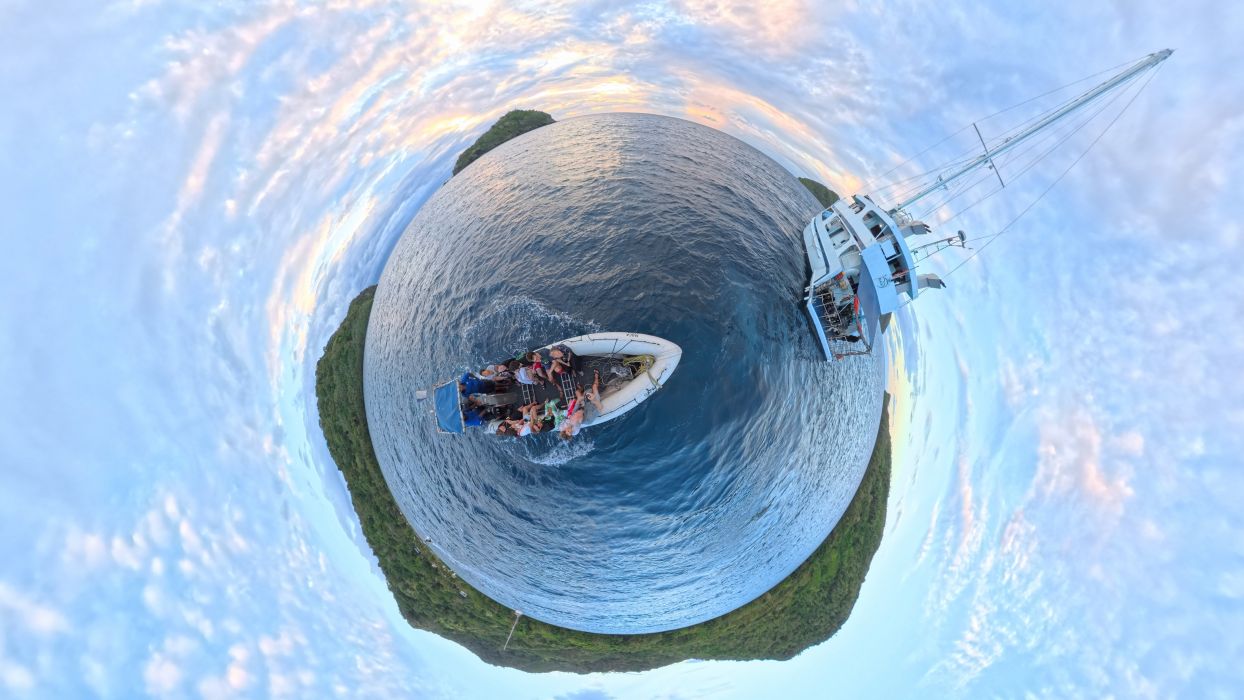
The NAI'A carries you to some of the most
pristine and unique areas of Fiji in great style and comfort. They have
one of the great crews among all liveaboards friendly and hard working.
There's nothing like sitting out with them on the bow after a night dive,
drinking kava and listening to their sweet three-part Fijian harmonies
under a starlit sky
![]() |
![]() |
![]() |
![]() |
![]() |
![]() |
A
36.5 metre (120 foot) motor sailer with a 9 metre (30 foot) beam, she has
12 crew and carries up to 18 passengers in 9 deluxe staterooms, 8 with
private heads. The ship is a labour of love for owner and captain Rob Barrel.
Build in Amsterdam in 1979, Rob's extensive 1993 refit turned this into
one of the most impressive liveaboards found anywhere. The main salon is
almost 700 square feet finished with native hardwoods. Dining is at tow
long tables separated by a bookcase. The library is packed with the latest
in marine biology plus there's an entertainment centre for viewing the
day's videos, a CD player, and a slide projector to show off slides developed
in the ship's E-6 processor. Cereals are set out before the first dive
and a hot breakfast served afterwards. Lunch and dinner is never the same
and locally grown fruits and vegetables are used as much as possible. The
main dive prep area is amidships; two columns with six benches each plus
large bin storage below the bench. Dive briefings are thorough. A large
camera room is just forward with multilevel storage shelves, benches and
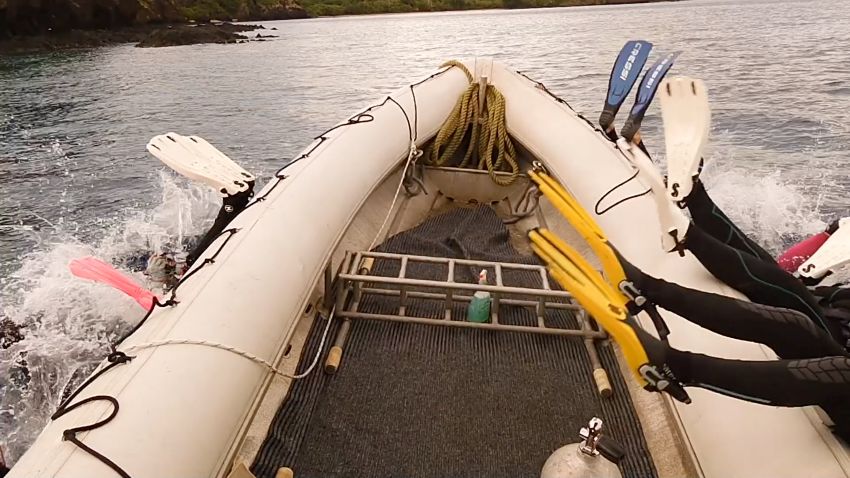
dunk tanks for 15 photographers. All diving is dine from two well-managed
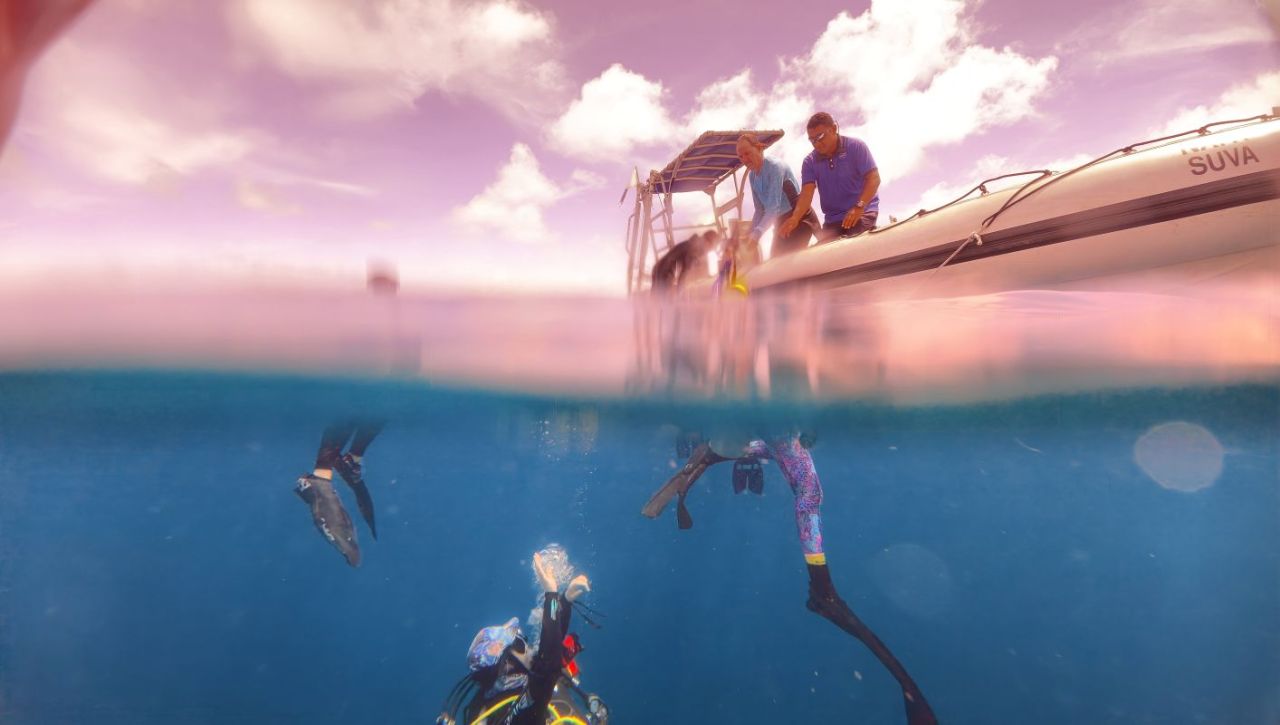
5.8 meter Naiad skiffs with 60 h.p. motors; diving is unlimited. Dive sites
are always less than five minutes from the NAI'A. You're assigned to a
skiff so there's no confusion about which one to board; just toss on your
BC and do a backroll to get into some great diving. As the dive ends the
skiffs circle the area; while one takes divers back to the ship, the other
picks up other divers so there's usually very little wait at the surface;
hot towels are available after each dive. The crew helps you as much or
as little as you desire. Dives are scheduled for 7:30 a.m., 11:00 a.m.,
2:00 p.m. and 6:30 p.m., but the crew is available for you any time you
wish to dive. Although strict depth limits aren't enforced, computers are
encourage. Because of the wealth of beauty at relatively shallow depths,
there's not much need to go deep anyway. The NAI'A departs from Lautoka
and the itinerary covers this area, Bligh Waters, Namena, Wakaya, Gau (450
miles on 10-day charter). This luxury liveaboard provides first-class accommodation
and access to world-class diving. Specifically designed for expeditionary
diving, the NAI'A visits some of the finest dive sites in the world; one,
E6, is considered by Stan Waterman to be the finest dive site there is.